What Your Wedding Dress Is Made Of Matters More Than You Think: A Fabric Guide for Every Bride
When most brides imagine their wedding gown, they picture silhouette first — the sweeping A-line, the sleek column, the voluminous ballgown. Fabric, by contrast, tends to feel like a technical footnote, something left to the seamstress or the designer. But the material that wraps your body on one of the most photographed, most physically demanding days of your life is not a footnote. It is the story.
The right fabric moves with you. It breathes in July heat. It catches light in a candlelit ballroom. It sits gently against sensitive skin without irritating, wilting, or betraying you in the middle of your first dance. The wrong fabric does the opposite — and no amount of stunning beadwork will compensate for a gown that leaves you counting the minutes until you can take it off.
Here is what every bride should understand before she falls in love with a dress on a hanger.
Silk: The Gold Standard With Real-World Conditions
Few fabrics carry the prestige of silk. Silk charmeuse, silk satin, and silk organza appear across the most celebrated bridal collections year after year, and for good reason: the material has a natural luminosity and a fluid drape that synthetic alternatives have never quite replicated. Against the skin, genuine silk feels cool and smooth, making it a sensory pleasure for brides who prioritize that quality of touch.
However, silk demands specific conditions to perform at its best. In high-humidity climates — think outdoor summer ceremonies in the Southeast, coastal celebrations in the Carolinas, or garden weddings across the Gulf states — silk can absorb moisture and lose its crispness. Perspiration leaves marks more readily on silk than on many other fabrics, which is worth considering honestly before committing to it for a warm-weather event.
Silk also interacts with skin undertones in ways that matter. Ivory silk tends to warm the complexion, making it particularly flattering on brides with golden or olive undertones. Bright white silk, by contrast, can appear stark against very fair or pink-toned skin. When trying on silk gowns, pay attention not just to how the fabric looks in the mirror but how it reflects light onto your face — that reflection tells you everything.
Tulle: The Fabric That Lives in Volume
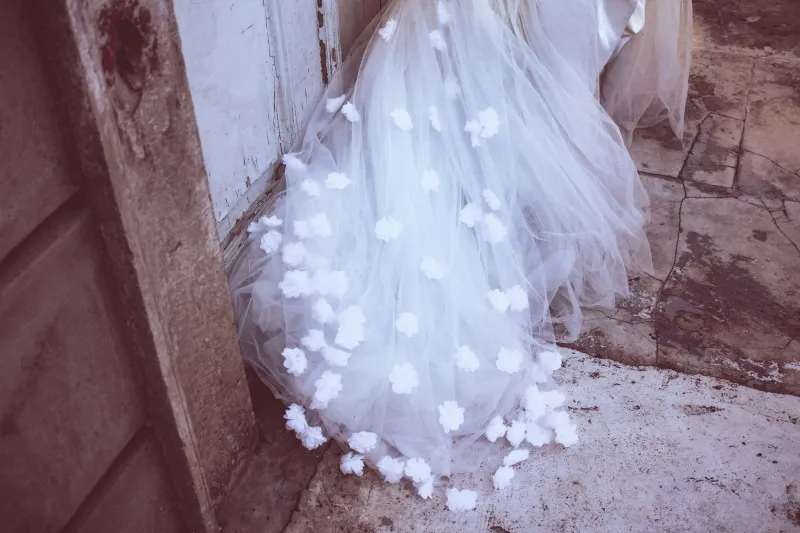
Tulle is the architectural workhorse of bridal fashion. It constructs the ballgowns that fill entire dressing rooms, the layered skirts that photograph like clouds, and the cathedral veils that trail across ceremony aisles. Its lightness is its defining quality — multiple layers of tulle can create extraordinary volume without the weight that would otherwise accompany such scale.
For brides concerned about comfort across a long day, tulle-heavy gowns are worth examining closely before purchasing. The fabric itself is featherweight, but sheer volume adds physical presence that some brides find tiring by the reception's midpoint. Try sitting, dancing, and navigating stairs in the fitting room. A gown that feels magical standing still should also feel manageable in motion.
Climatically, tulle performs reasonably well across a range of environments. It does not trap heat the way heavier fabrics do, though layered underskirts beneath a tulle overskirt can change that equation. In outdoor settings with wind, tulle behaves unpredictably — a romantic quality in photographs, but occasionally a practical challenge for the bride herself.
Regarding skin tone, tulle's sheer quality means the color of the underlining fabric matters as much as the tulle itself. A blush-lined tulle skirt reads very differently against deep skin tones than it does against fair ones. Ask your bridal consultant to show you the underlining options and assess each combination in natural light.
Lace: Texture, Weight, and the Question of Sensitivity
Lace occupies a category of its own in bridal fashion. Chantilly, Alençon, Venetian, and guipure lace each carry distinct visual personalities, and their structural differences affect how they wear against the body. Chantilly lace, delicate and fine, is the most lightweight and tends to lie softly against the skin. Alençon, with its raised cord outlining the pattern, carries more texture. Guipure, a thicker lace with no net backing, has a sculptural quality but can feel stiffer and heavier than its more delicate counterparts.
For brides with sensitive skin — a category that includes far more people than often admit it in the fitting room — the interior finish of a lace gown is critical. Many lace dresses are fully lined, which resolves the issue entirely. Others feature lace that meets the skin directly, particularly at the neckline, back, and arms. Before purchasing, wear the gown for at least twenty minutes and pay attention to any areas of friction or irritation. What feels fine at ten minutes may become uncomfortable at hour three.
Lace also performs differently in varying climates. In dry, temperate regions — the Pacific Northwest outside of summer, the mountain West, New England in autumn — lace holds its shape and texture beautifully. In humid conditions, certain lace weaves can absorb moisture and feel heavier as the day progresses. This is not a reason to avoid lace in warmer climates, but it is a reason to ask your bridal boutique specifically how a given gown has performed in warm-weather settings.
Cotton and Linen Blends: The Practical Choice With Genuine Elegance
Cotton and linen blends have long been underestimated in bridal fashion, associated more with casual destination weddings than with formal ceremony. That perception has shifted considerably as brides increasingly prioritize comfort and authenticity in their choices. Cotton lawn, cotton voile, and linen-cotton blends offer breathability that no synthetic and few natural luxury fabrics can match, making them genuinely exceptional choices for outdoor summer weddings, beach ceremonies, and any setting where temperature management matters.
These fabrics photograph beautifully in natural light and tend to feel immediately comfortable against the skin, even for brides who typically find structured fabrics difficult to wear. The trade-off is formality: cotton and linen blends carry a relaxed, organic quality that suits certain aesthetic visions perfectly and conflicts with others. They are ideal for the bride who wants her dress to feel like an extension of herself rather than a costume.
Against skin tones, cotton blends in white and off-white tend to be forgiving across a wide range of complexions because the fabric's matte finish absorbs rather than reflects light, reducing the contrast effect that can make stark whites feel harsh.
Mikado and Duchess Satin: Structure as a Feature
For brides who want a gown that holds its shape with authority — that stands rather than drapes — mikado and duchess satin are the fabrics to consider. Both have a smooth, weighty surface with a subtle sheen, and both provide the kind of structure that creates and holds a silhouette rather than simply following the body's contours.
This structural quality is particularly useful for column and fit-and-flare silhouettes, where the fabric itself contributes to the visual line of the gown. It is also worth noting for brides who prefer a gown that feels substantial — there is a particular confidence that comes from wearing something with genuine physical presence.
The weight of these fabrics, however, means they are better suited to climate-controlled interiors than to outdoor summer events. For fall and winter weddings, formal ballroom celebrations, or any setting where warmth is welcome rather than a concern, mikado and duchess satin are exceptional choices.
The Final Consideration: Trusting Your Body's Intelligence
Every piece of guidance in this article is a starting point, not a rule. Fabric behavior is influenced by how a gown is constructed, how it is lined, how it is altered, and how it interacts with your specific body. The most reliable test is time spent wearing the dress — not just standing in it, but sitting, dancing, embracing people, and moving through space.
When you find a fabric that passes that test, you will know it. Not because someone told you it was the right choice, but because your body simply stops thinking about the dress. And that ease — that quiet, physical confidence — is precisely what every bride deserves to feel from the first moment to the last.