When the Room Is Divided: How to Handle Conflicting Dress Opinions and Still Choose the Gown That's Right for You
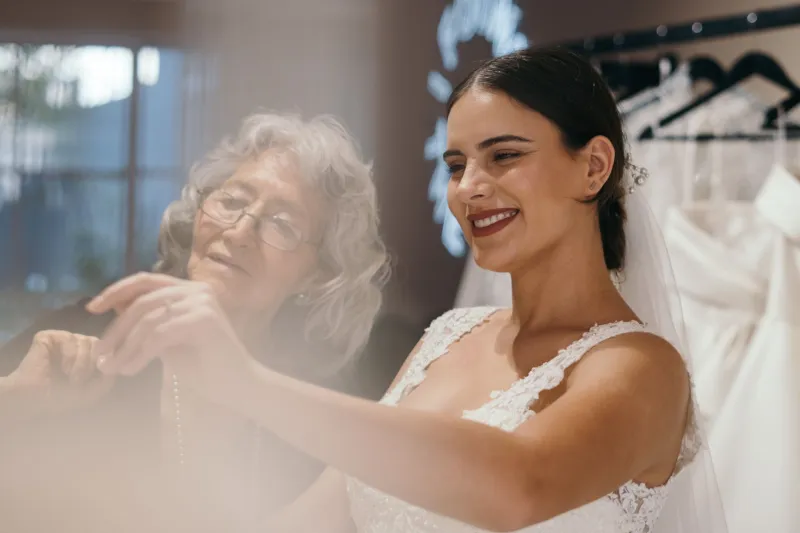
You stepped out of the fitting room, caught your reflection in the mirror, and felt something shift. This was the one. The silhouette, the fabric, the way it moved — everything aligned. And then someone in your entourage tilted her head and said, "I don't know. I thought you'd go for something more traditional."
Just like that, the certainty you felt moments ago began to waver.
Conflicting feedback during the dress selection process is one of the most emotionally charged challenges a bride can face. The people offering their opinions love you deeply and want the best for you — which is precisely what makes navigating their input so complicated. Learning to distinguish between feedback that serves you and feedback that simply reflects someone else's preferences is one of the most valuable skills you can develop during this season of wedding planning.
Why the Opinions Feel So Heavy
Bridal appointments are uniquely vulnerable experiences. You are standing in front of people you love, wearing something that represents one of the most significant days of your life, asking — implicitly or explicitly — for their approval. That dynamic creates the perfect conditions for other people's preferences to feel like authoritative verdicts.
It is worth remembering that the people in your dressing room are also emotionally invested. A mother may have spent years imagining this moment. A best friend may have strong aesthetic opinions that have nothing to do with what flatters you. A future mother-in-law may be projecting her own sense of occasion onto your choices. None of this is malicious. All of it can be genuinely unhelpful.
Recognizing that feedback is filtered through someone else's experience — not your body, your taste, or your vision for your wedding — is the first step toward evaluating it clearly.
The Difference Between Useful Feedback and Personal Preference
Not all criticism is created equal. Some observations are genuinely worth considering; others are simply expressions of someone else's aesthetic sensibility dressed up as concern.
Feedback worth taking seriously tends to be specific and grounded in something observable. Comments such as "The back closure looks uneven — it may need adjustment" or "I noticed you keep pulling at the neckline; does it feel comfortable?" point to something concrete and actionable. This kind of input can help you make a more informed decision.
Feedback that functions as noise is often vague, comparative, or rooted in expectation rather than observation. Phrases like "It's just not what I pictured for you," "I thought you'd want something more classic," or "It doesn't look very bridal" reveal more about the speaker's preferences than about the dress itself. These opinions are not wrong — they are simply not relevant to whether the gown is right for you.
A useful exercise is to ask yourself: Does this feedback address how the dress fits, how it functions, or how it makes me feel — or does it address what someone else expected me to choose? The answer will usually clarify how much weight to give the comment.
When to Trust Your Gut
The emotional response you have to a dress is data. If you felt an undeniable sense of rightness before the feedback began, that reaction belongs to you and deserves serious consideration.
That said, gut feelings and social anxiety can occasionally masquerade as one another. It is worth asking yourself a few honest questions:
- Would you feel confident in this dress if no one had said anything?
- When you imagine yourself wearing it on your wedding day, does the feeling remain positive?
- Are you reconsidering because something genuinely concerns you, or because you want to restore harmony in the room?
If your answers consistently point back to the dress, that is meaningful. Confidence in a wedding gown does not require unanimous approval from your entourage. It requires your own.
When to Genuinely Reconsider
There are circumstances in which pausing to reflect is the wise choice. If multiple people — independently of one another — raise the same specific concern, it may be worth examining whether that concern has merit. If your own doubts existed before anyone spoke, the feedback may simply be surfacing something you had already sensed.
Additionally, practical considerations sometimes outweigh emotional attachment. If several trusted voices note that a dress appears significantly different in photographs, or that the train is unmanageable given your venue, these are logistical realities worth factoring into your decision.
Reconsidering is not a sign of weakness. It is a sign of thoughtfulness. The distinction lies in whether you are revisiting your choice because new information has genuinely shifted your thinking — or because you are trying to make other people comfortable.
Managing Expectations With Family and Friends
Prevention is always more effective than damage control. If you have a clear sense of your aesthetic before appointments begin, consider communicating it in advance. Letting your entourage know that you are drawn to minimalist silhouettes, or that you are open to non-traditional options, sets a framework for feedback before the first gown is even tried on.
It is also entirely reasonable to set boundaries around the size and composition of your shopping party. Bringing fewer people — or choosing attendees who understand that their role is to support your vision rather than impose their own — can reduce the noise considerably. Many brides find that their most productive appointments are the ones with the smallest, most carefully chosen groups.
If you have already received conflicting feedback and the situation feels unmanageable, a direct and gracious conversation can go a long way. Something as simple as "I really value your perspective, and I want you to know I've been thinking carefully about all of it. I've decided to move forward with the dress I felt most like myself in" honors the relationship without surrendering your decision.
A Final Word on Bridal Autonomy
Your wedding dress is not a group project. It is, at its core, a deeply personal expression of how you want to feel on one of the most meaningful days of your life. The people who love you may have opinions — sometimes loud ones — but the final choice belongs entirely to you.
The most confident brides are not the ones who received unanimous approval. They are the ones who learned to distinguish between love and noise, between genuine concern and projected expectation, and between the dress someone else imagined for them and the one that made them feel, for one extraordinary moment in a fitting room, completely and unmistakably themselves.
Trust that feeling. It is worth protecting.