In Love With a Gown You Can't Zip? A Bride's Field Guide to Sample Sizes, Measurements, and Second Chances
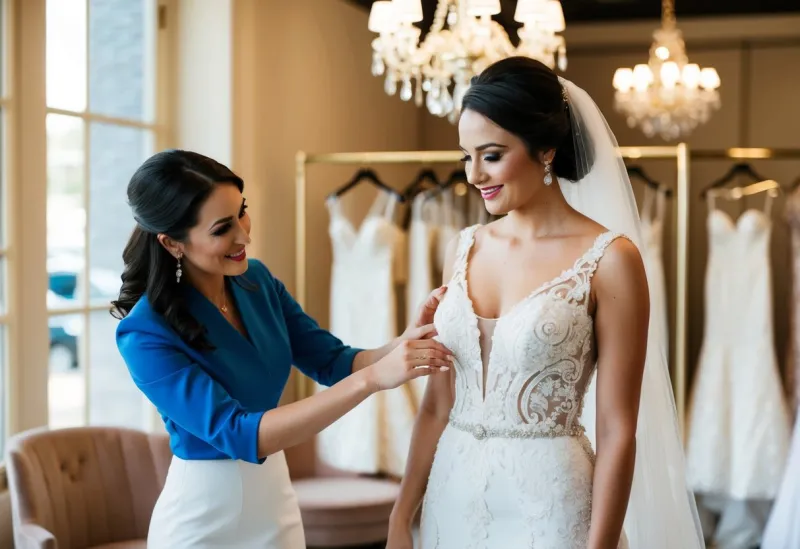
Photo: bridal consultant clipping wedding dress sample on bride boutique, via koala.sh
Here is a scene that plays out in bridal salons across the country every weekend: a bride finds The Dress. It is unmistakably The Dress. And then the consultant appears with a garment bag containing exactly one sample — in a size 10, when the bride wears a 16. Or a size 2, when she wears an 8. The moment deflates, and the bride quietly wonders whether the gown was ever really an option at all.
It was. But understanding why this happens — and how to navigate it — requires knowing how the bridal industry actually operates.
Why Salons Can't Stock Every Size
Bridal samples are expensive. A salon might carry four hundred gowns, and stocking each in a full size run would be financially impossible. So most boutiques buy samples in a limited range — frequently sizes 8 through 12, sometimes with a handful of extended sizes — and rely on clips, clamps, and panels to simulate fit on everyone else. This is an industry logistics problem, not a comment on your body. Every bride, at nearly every size, encounters the clamp at some point.
What a Clamped Gown Can — and Can't — Tell You
A skilled consultant can cinch a too-large sample with clips along the side seams and back, and honestly, the illusion is often remarkable. What clips reveal well: the color against your skin, the neckline, the movement of the skirt, the overall silhouette, how the fabric photographs in light.
What clips cannot reveal: whether the bodice construction will support you, how the dress behaves at your natural waist, whether the hip area will pull, and how the gown feels after thirty minutes of standing. Be candid with yourself about those gaps. If a gown's appeal depends entirely on a detail near the waist or bust, ask the consultant to walk you through how that detail is constructed and how it has fit other brides.
Trust the Measurements, Not the Tag
Bridal sizing runs smaller than streetwear — often four to six sizes. A bride who wears a 12 in denim may order a 16 or 18 in bridal, and there is nothing ominous about that number. It is a pattern designation, not a verdict.
The more reliable exercise: ask for the manufacturer's measurement chart for the specific gown, then compare it to your current measurements. Designers publish bust, waist, and hip specifications per size. If your measurements fall within an inch of a size's chart, the gown will very likely fit well after alterations. If they fall well outside it, have an honest conversation about whether that particular cut flatters your proportions — some silhouettes are forgiving across sizes; others are not.
What Alterations Can Fix — and What They Can't
A talented seamstress can take in or let out side seams (typically up to two sizes either direction, depending on seam allowance), shorten hems, add cups, raise necklines, and adjust straps. What alterations cannot do: add significant fabric to a gown that is too small, restructure internal boning dramatically, or change the fundamental geometry of a cut. Ordering too large and sizing down is standard practice; ordering too small and hoping is not a strategy.
Advocating for Yourself in the Boutique
You are entitled to a full shopping experience regardless of the sample on the rack. A few phrases worth using:
- "Can you show me the designer's measurement chart for this gown?"
- "How many sizes can this style realistically be taken in or let out?"
- "Does this designer offer custom sizing or made-to-measure?"
- "Can you order a swatch of this fabric so I can see it against my skin?"
A good salon will answer all four without hesitation. If a boutique makes you feel like an inconvenience for not fitting the sample, that is information about the boutique — take your budget somewhere it will be celebrated.
The Bottom Line
The dress you love is not defined by the zipper on a sample. Order based on your measurements, lean on a seamstress you trust, and give yourself a fitting schedule with room to breathe — ideally eight to ten months before the wedding. The gown was never the size on the tag. It was always the one that looked like you.